
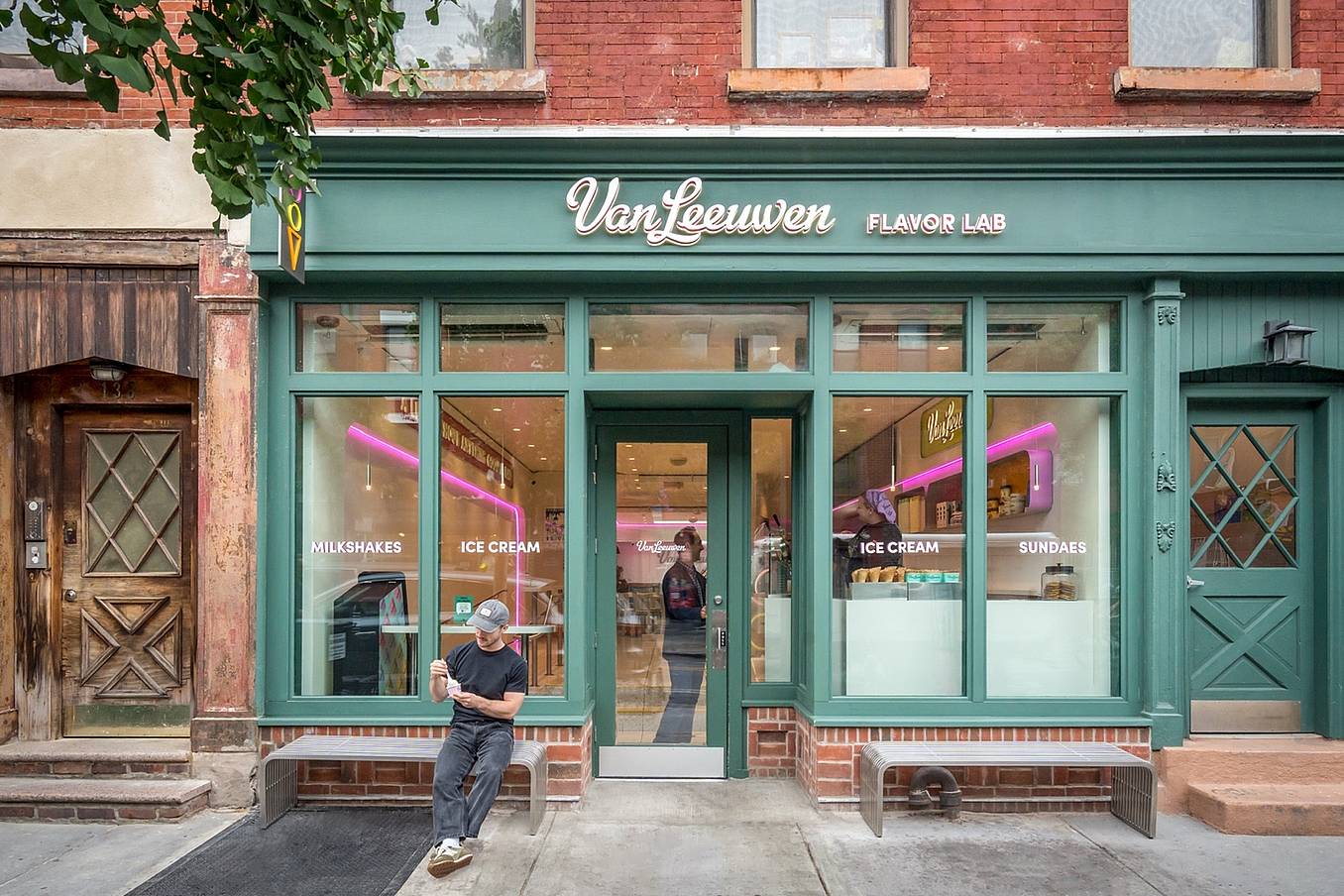
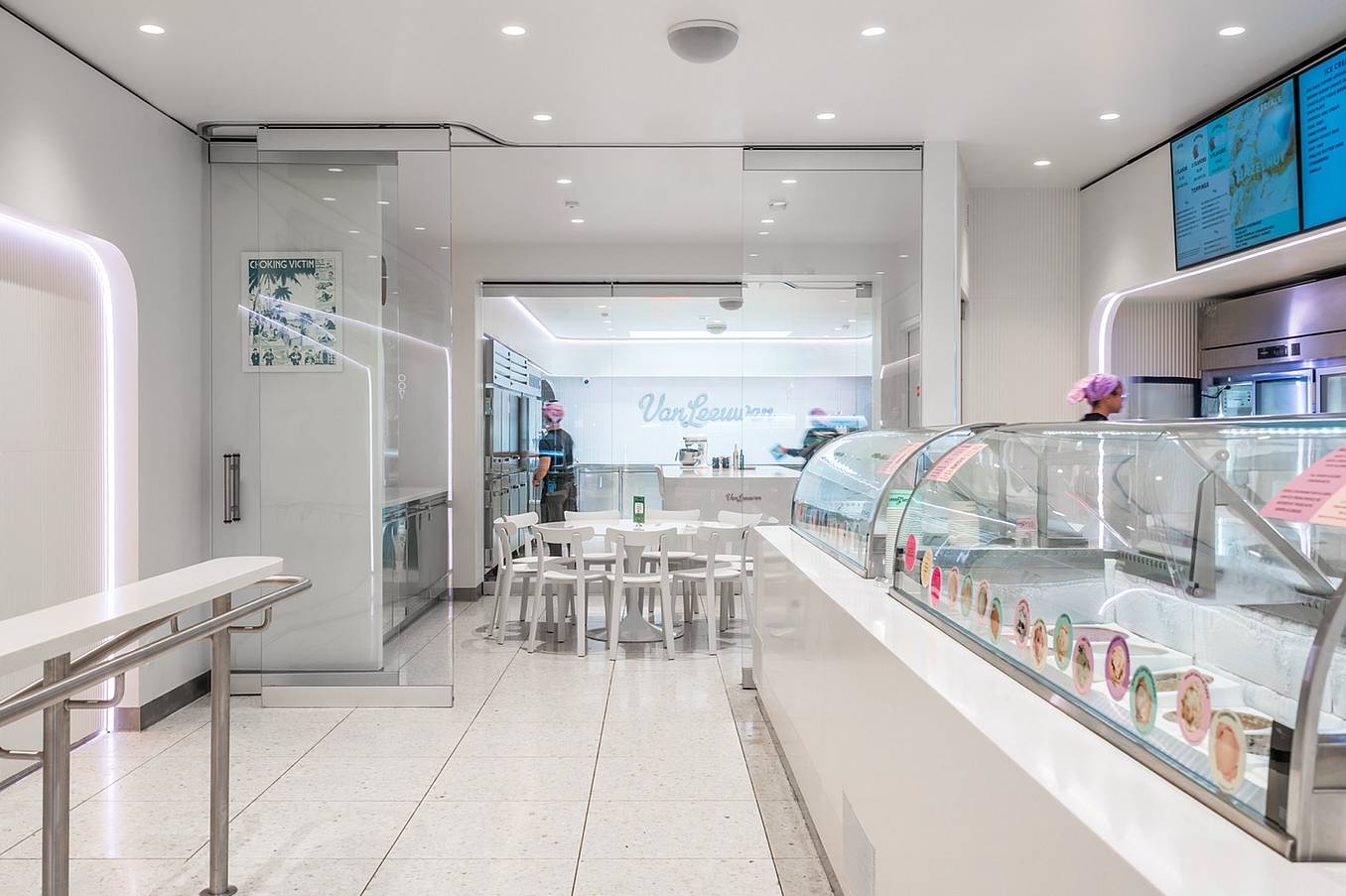
On iconic Franklin Street in Greenpoint, Brooklyn, there is an ice cream shop where the room tells as much of the story as the menu. Van Leeuwen’s Flavor Lab looks, at first glance, like a familiar urban neighborhood scoop shop: a welcoming retail storefront design, glowing menu boards, and a steady line of people waiting for cones. A few seconds later, you notice what is happening just beyond the frameless glass walls. Behind the counter and separated only by a transparent, all glass plane, a full R&D kitchen weighs ingredients, spins test batches, and refines recipes that may eventually land in grocery freezers and shops everywhere.
AtelierTek Architects was asked to make all of this coexist inside a narrow Brooklyn shell. The space had to function as a neighborhood retail store, a working “flavor laboratory” for the brand, a flexible tasting room, and a small event space. The solution was a bright, minimal interior organized around NanaWall HSW75 frameless glass walls, which allow a single compact floor plan to function as three distinct spaces without ever feeling chopped up or chaotic.
One Compact Retail Storefront Design, Three Demanding Roles with Frameless Glass Walls
The Flavor Lab carries a demanding use of space - it is a fully operational shop serving classic and vegan ice cream flavors to a local crowd. It is also the place where ‘Lab-only’ creations are developed and refined, including collaborations like Kraft Mac & Cheese and Sabrina Carpenter’s espresso flavor, among others, in the constant rotation. On top of that, it serves as a small event venue where architects, partners, and fans gather for tastings, talks, and press-worthy moments.
A Continuous Plan That Feels Larger Than Its Footprint
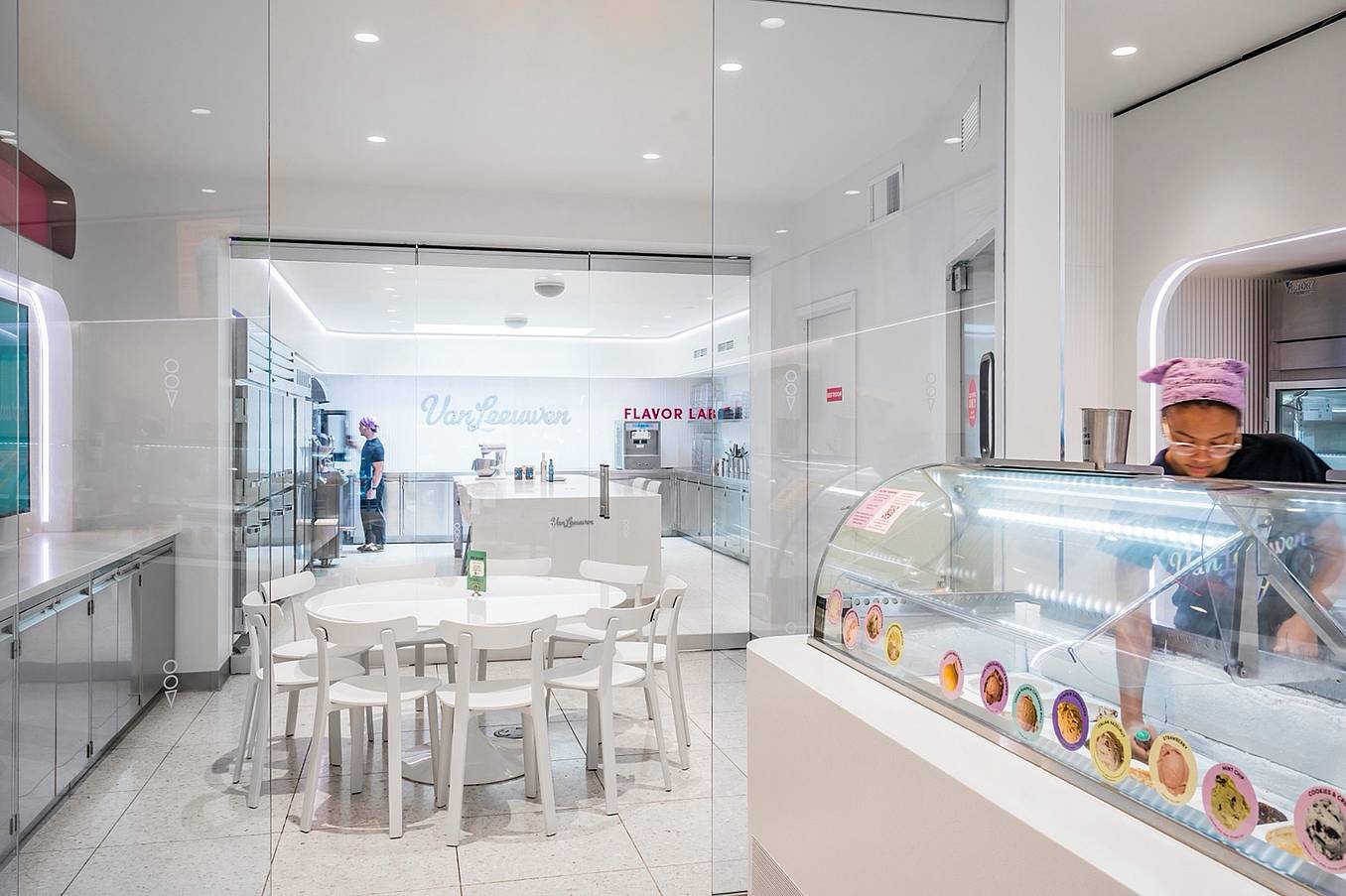
Rather than pushing the lab to the back and hiding it behind a solid wall, AtelierTek designed everything into one continuous flow. The front of the space reads as a clear retail zone: counter, menu boards, and seating area. At the center sits a shared table that can act as everyday seating, a tasting table, or an event focal point. At the rear, a fully equipped R&D kitchen fills the back wall. All three zones are visually connected by transparent, frameless glass walls that retract, yet the shop never feels cluttered or confusing. Customers can tell at a glance where to order, where to linger, and where the real work of flavor development is happening. This design approach allowed the compact square footage to serve three business functions simultaneously. The space feels larger than its footprint, has uninterrupted sightlines, and can shift from a busy afternoon service to an intimate event space instantly!
A Sleek & Minimal Design, “Flavor Lab” Puts the Product First
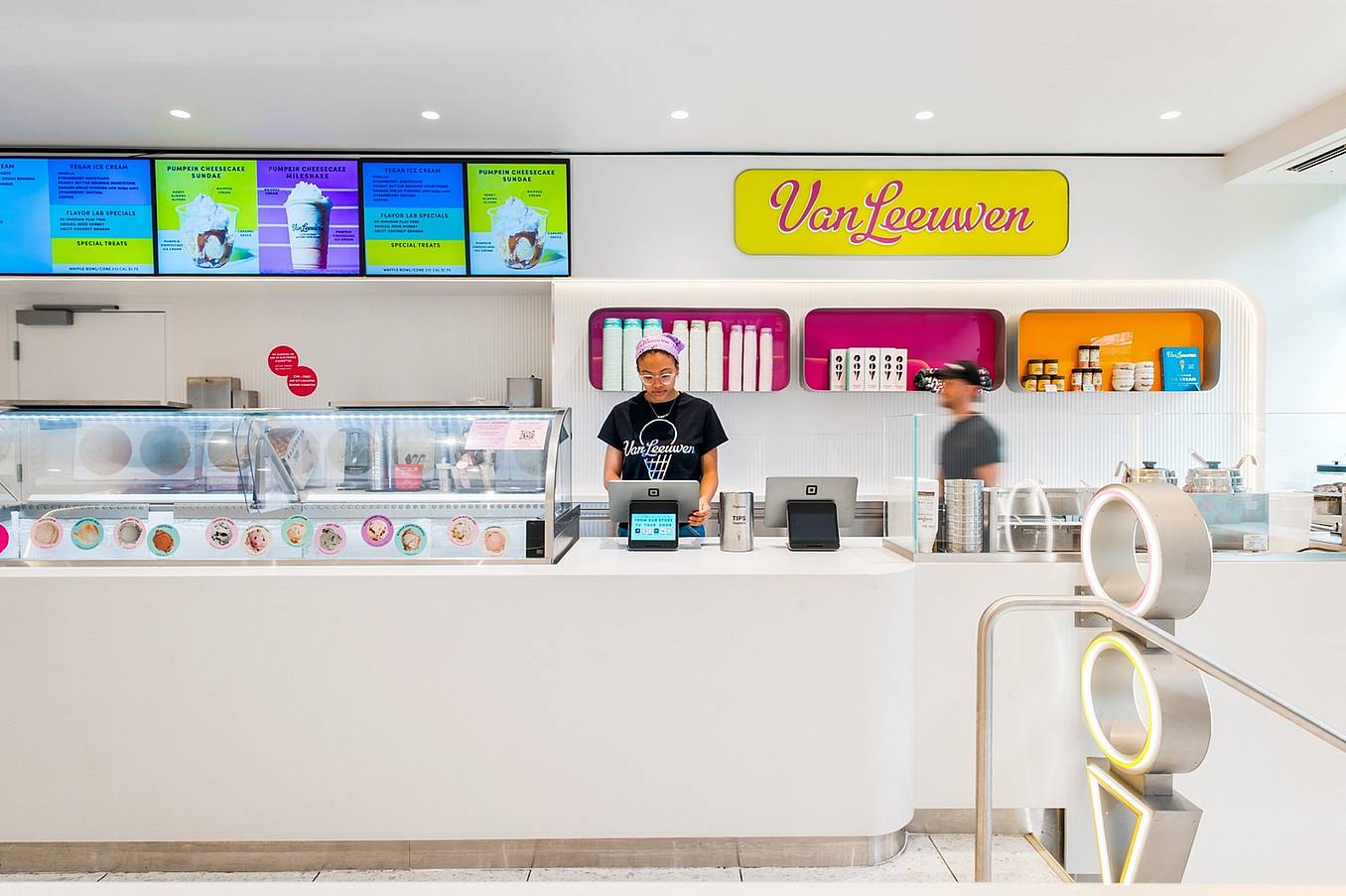
The store interior is deliberately quiet - floors, frameless glass walls, ceiling skylight, and bright, crisp white product cases. The geometry is simple and legible. There is no themed décor, no retro-ice-cream-parlor references, and no heavy patterns that compete with the main attraction: the flavors. Color comes primarily from Van Leeuwen’s pints and cartons, from the menu boards, and from a few controlled brand accents. Against a neutral background, the ice cream becomes the focal point of every view, drawing customers to the case. Customers can take Instagram-worthy photos from anywhere in the space with a clear line of sight to the action. This is important for a brand that lives on social media feeds as much as in the brick-and-mortar retail environment.
Light, Color, and Visibility in Retail Storefront Design
The generous retail storefront design brings in ample natural light from the street, while a skylight at the back streams light across the length of the plan. Because the key partition in the middle of the store is floor-to-ceiling glass rather than drywall, daylight is never interrupted. It stretches across white surfaces, reflects off the frameless glass panels, and makes the whole space read as one continuous, bright laboratory. The result is a room that feels calm even when it is working hard. The architecture quietly matches the brand’s reputation for straightforward ingredients and thoughtful design.
Total Transparency and Versatility as a Design Move
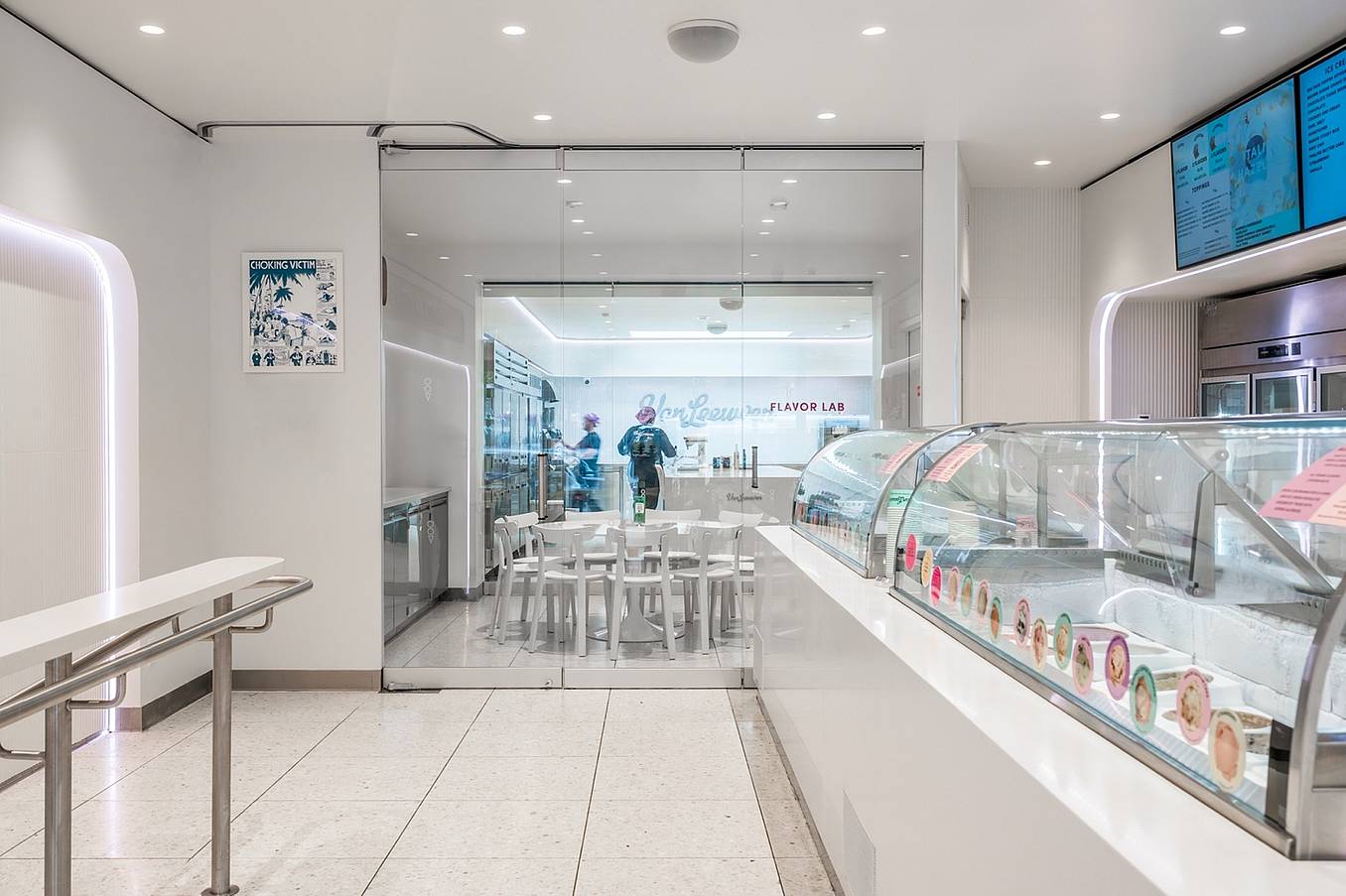
The decision to keep the R&D kitchen fully visible is a defining design decision. The glass line between customer and kitchen is not a decorative gesture; it is the element that turns production into part of the brand story. Through the frameless glass walls, guests watch real work: mixers running, ingredients being weighed, recipes being adjusted, and textures being checked by hand. The back-of-house activity, usually hidden in a separate room, becomes a visible part of the visit. That visibility builds trust around ingredients and process, but it also creates genuine curiosity. Visitors do not just see a finished scoop; they see the steps that led to it. For the neighborhood, the Flavor Lab begins to feel less like a static store and more like a working studio that also serves sundaes.
Performance Design Meets Daily Use with Frameless Glass Walls
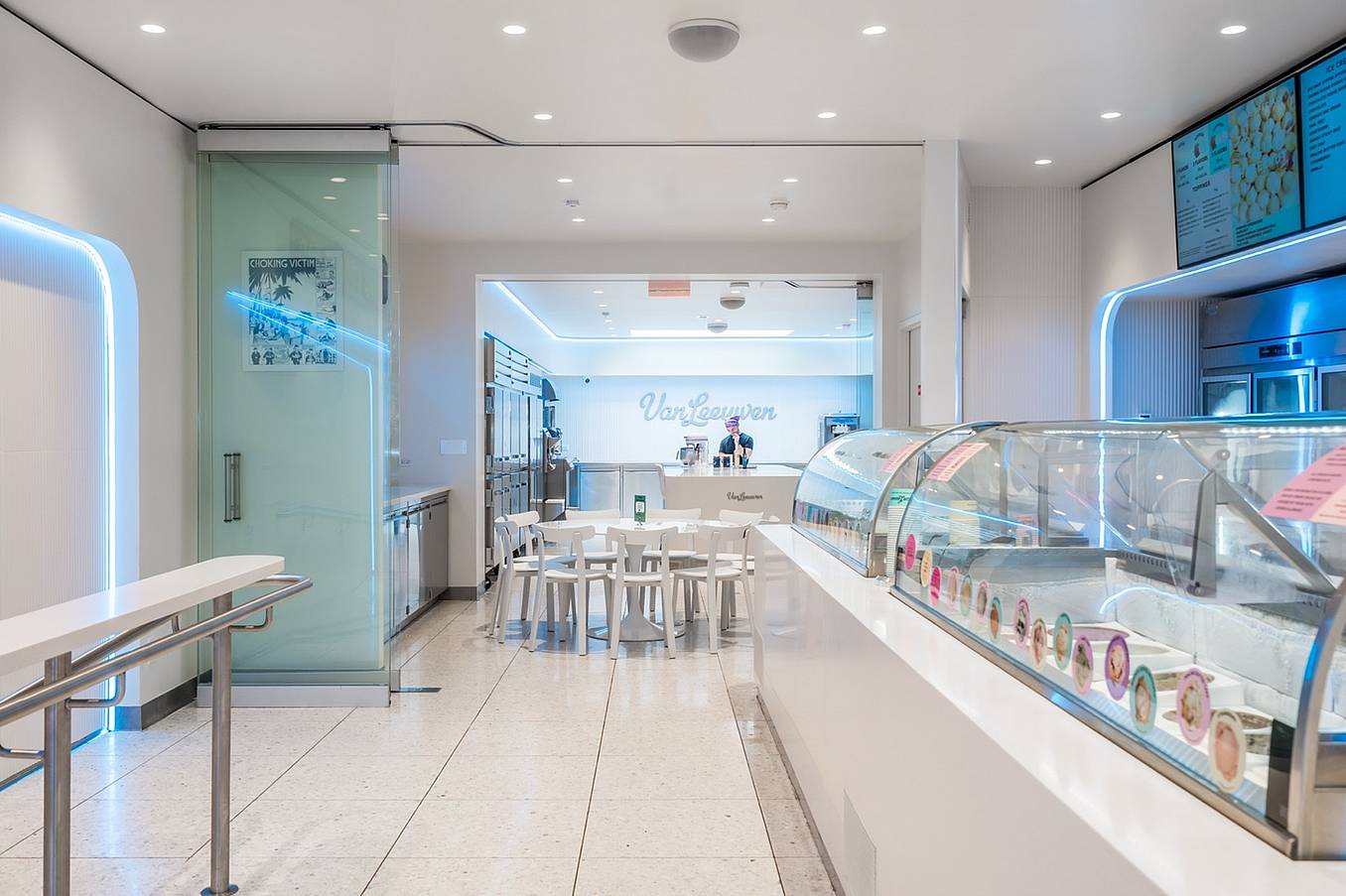
The frameless glass walls inside this high-traffic ice cream shop must do more than look minimal and sleek. They have to be easy to operate, withstand constant use, support comfort and code requirements, and maintain security after hours. The doors span the opening between the retail space and the R&D zone and quietly disappear when needed. The interior door opening is roughly 10'-7" wide by 8'-9 1/16" tall, adorned with floor-to-ceiling frameless opening glass doors. All three panels slide and stack to the left, neatly out of the way into a custom parking bay, creating entirely unobstructed openings for events and tastings.
Top-hung HSW75 panels lock into discreet eccentric floor sockets, keeping the floor plane clean and easy to navigate in a high-traffic retail environment. They help accommodate building settlements and feature quick release floor bolts with spring loaded security features. Ease of operation and smooth interior transitions matter in a space that sees strollers, wheelchairs, carts, and high foot traffic daily. The all glass doors have slim, continuous rails at the top and bottom in a clear anodized finish, and stainless steel brushed hardware, so everything guests touch feels consistent with the clean, minimal “lab” aesthetic.
Turning Production into Part of the Retail Guest Experience
In everyday mode, the see-through wall is fully closed. Customers order at the counter and look straight through the frameless glass walls, into the lab. The zones feel distinct, but the connection is obvious. When the team hosts tastings or Lab flavor days, selected panels slide aside to open the central table and expand circulation. Guests can move freely between the retail area and the flex zone and watch from a closer vantage point. The glass still helps define edges and protect equipment, but the line between guest and lab softens. The glass doors park neatly in compact bays, so the full depth of the retail storefront design, from the entry to the back wall, reads as one continuous room.
Final Thoughts
For architects, designers, and brand teams working on the next generation of retail spaces, the Van Leeuwen Flavor Lab offers a clear takeaway. Great design should start with a focused story about how the space should work, retail transparency, and the number of roles a single room needs to fill.
In the heart of Brooklyn, this bright, minimal “lab” is where ice cream reigns supreme, and the process becomes part of the experience. The frameless glass walls let a narrow retail storefront design behave like a versatile shop, working studio, and community space all at once.
Learn more about how moveable glass walls can transform retail storefront design by visiting our NanaWall inspiration gallery!
